With
Edith Biscaro, Eddy D'aranjo, Clémence Delille, Marie Depoorter, Volodia Piotrovitch d'Orlik
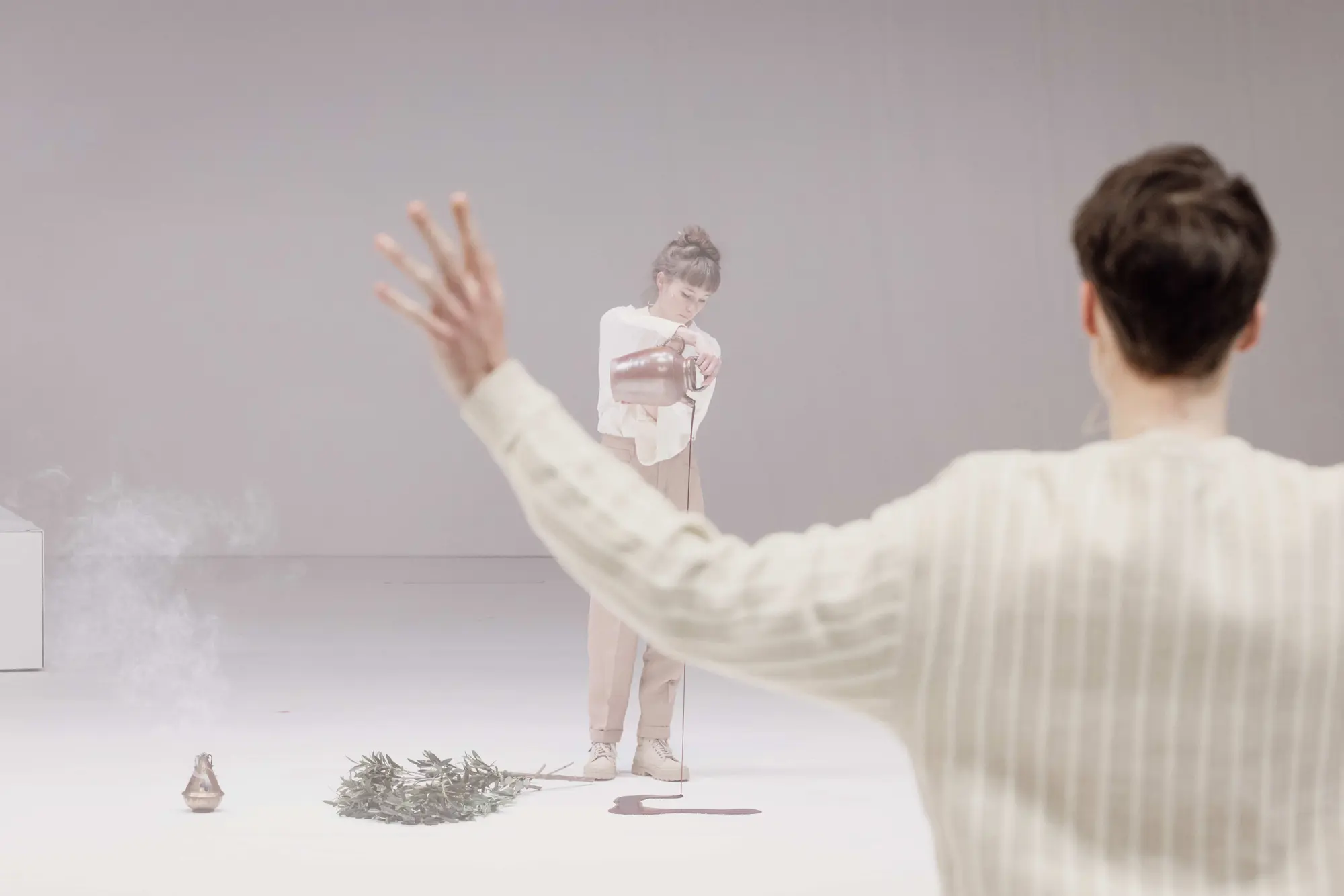
Œdipus Rex by Sophocles presents us with one of the earliest instances of incest in Western literature. Behind this founding myth lies a blind spot, namely that of the reality of incest and its millions of victims. What can art do in the face of incest, and what effect does it have on image and language? By means of a first-person enquiry of an intense, emotionally charged kind, Eddy D'aranjo furthers his research into political theatre. Documentary and performance are blended together – two truth-based regimes aimed at showing us reality exactly how it is, and for what it is.
Cast
based on
Sophocles
text and direction
Eddy D’aranjo
dramaturgy
Volodia Piotrovitch d’Orlik
set and costume design
Clémence Delille
lighting designer
Edith Biscaro
video designer
Pierre Martin Oriol
sound designer
Martin Hennart
in collaboration with
William Ravon
stage director assistant
Margot Papas
costume and set design assistant
Zoé Gaillard
set design, costume design, props
Ateliers de l’Odéon Théâtre de l’Europe
production
Odéon Théâtre de l'Europe
Five dates
13.8 billion years ago. Creation of the Universe (Big Bang).
3.8 billion years before present. First known traces of living organisms on Earth. Life is exclusively aquatic for 3.4 billion years.
1990 - 2000. Eddy D'aranjo grows up in Laon, Picardy. He discovers theater through a workshop at the Charlemagne secondary school, classified as a ZEP (REP+). He enrolled in his high school's theater option, which enabled him to see Edward Bond's Naître, directed by Alain Françon, at the Théâtre de la Colline - a hyper-violent show that left him shattered and transformed. The same year, he took part in a trip to the Avignon Festival, financed by the Picardie regional council. Amazed, he attended Valère Novarina's L'Acte inconnu in the Cour d'honneur, a pantheistic song dedicated to the beauty of the world and the enigma of language, and decided to become a stage director.
20 billion years from today. The Universe is torn apart. The rate of expansion of the Universe increases indefinitely. Expansion becomes so rapid that it overwhelms the electromagnetic forces holding atoms and molecules together. The electromagnetic force that holds things together no longer has any effect, and matter unbinds. Clusters of galaxies, galaxies, and eventually the solar system, are “torn apart”. Soon, even atomic nuclei decompose, and the Universe as we know it ends in an unusual gravitational singularity.
100 billion years from today. Final collapse of the Universe. In this other possible time, expansion reverses and the Universe contracts to a dense, hot “final” state.
Practical Information
duration 4h
(with an intermission)
Tuesday to Saturday at 7:30 p.m., Sunday at 3 p.m.
No shows on Mondays
This show deals with the subject of incest: some scenes and dialogue may be disturbing to certain members of the audience.
not recommended for children under 16
surtitled in English every day